


### Blog Post:
Eco-friendly home renovation ideas can save you thousands on utility bills within just a few years—if you plan, budget, and document everything carefully. This guide breaks down realistic upgrades, tax credits, and proven tips U.S. homeowners are using in 2025–2026 to get the strongest ROI from green renovations. Let’s make every dollar you spend work harder for your wallet and the planet.
Key Takeaways
- Most eco-friendly home renovation ideas pay back in 3–7 years if you select high-ROI upgrades and capture all available tax incentives.
- Document specs, invoices, and certifications for every project to maximize your eligibility for the Energy Efficient Home Improvement Credit and local rebates.
- Vet green remodeling contractors for transparent pricing, credential proof, and reference reliability to avoid scope creep and delays.
- Why now — residential market context and adoption
- How to budget: project tiers, typical costs and expected ROI
- High-impact upgrades: costs, specs and performance (quick reference)
- Lifecycle costs & payback timelines for every common upgrade
- Sustainable materials & recycled options — costs, lead times and sourcing tips
- Hiring green remodeling contractors — common pain points and a vetting checklist
- Capturing incentives — step-by-step for the Energy Efficient Home Improvement Credit and local rebates
- Whole-home energy management & IoT integration: product picks, impact and rollout
- Sample project scopes with line-items, timelines and expected returns
- Documents checklist & simple ROI tracking worksheet (what to keep and how to file)
- Quick FAQ / overcoming objections: pricing, timelines, reliability
Why now — residential market context and adoption
Residential demand for eco-friendly home renovation ideas is booming: in 2024–25, U.S. homeowners drove 53.7% of the $371 billion sustainable-construction market and accounted for 43.5% of all green-building spend. Compared to just a decade ago, these numbers mean better contractor offerings, more competitive pricing, and greater availability of energy-efficient and recycled materials. As homeowners adopt even one green upgrade—such as switching to LED lighting or low-E triple-glazed windows—they’re capturing annual utility savings and adding property value [1]. For many, eco-renovation is no longer a luxury, but a logical investment anyone can plan.
How to budget: project tiers, typical costs and expected ROI
Every eco-friendly home renovation should start with a realistic budget and expectations on return. Here’s how the numbers pencil out for different project scopes:
- Surface Eco-Refresh ($150/ft²): Focused on low-VOC paints, energy-efficient lighting, refacing cabinetry, and recycled materials for home renovation. Minimal structural work, fast payback, and quick incentives documentation.
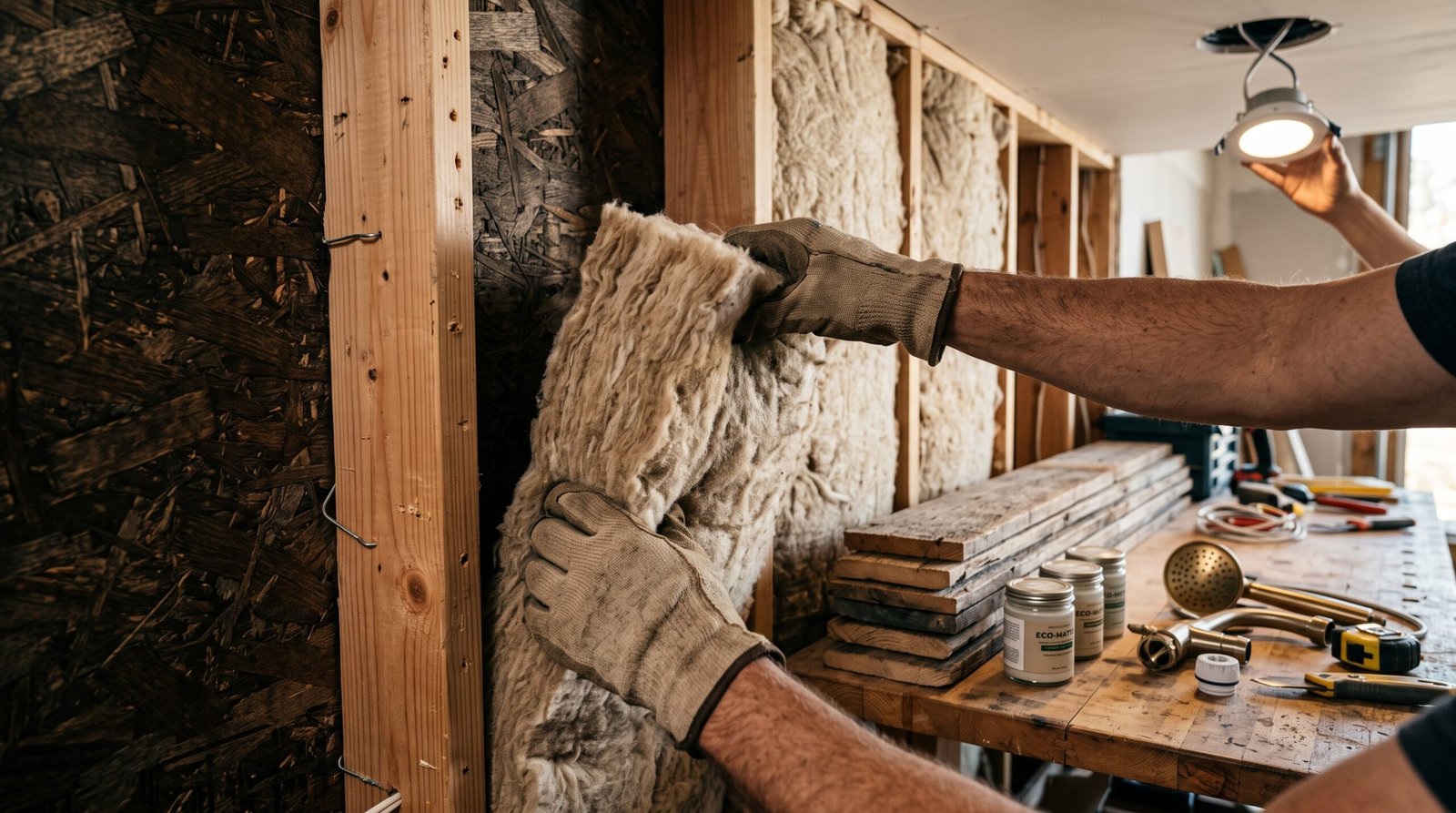
- Targeted Retrofit ($225–$300/ft²): Includes adding high-R insulation, replacing windows, and upgrading to ENERGY STAR appliances. Deeper energy savings, but longer timelines (material lead times of 4–12 weeks for sustainable materials).
- Full-Scale Retrofit ($300–$500/ft²): Whole-home approach—high-performance windows, spray foam insulation, full HVAC overhaul, 5-kW solar, and advanced building envelope. Highest upfront cost, but maximizes utility savings and ROI.
Typical eco-renovations range from $150 per ft² for surface upgrades to $300–$500 per ft² for full-scale retrofits; average annual utility savings are 15–30% (about $600–$1,200 per year). That yields a payback period of 3–7 years and an ROI of 12–18% over a 10-year horizon. For more detail, try our downloadable ROI worksheet.
High-impact upgrades: costs, specs and performance (quick reference)
Want the fastest payback? Focus on these high-ROI upgrades and make sure your contractors specify sustainable building materials and collect invoices for your energy efficient renovation tax credit:
| Upgrade | Spec/Benchmark | Cost (Installed) | Energy Saved | Tax Credit Eligible |
|---|---|---|---|---|
| Triple-glazed low-E windows | U-Factor ≤0.25, SHGC ≤0.20 | $800–$1,200/unit | 10–25% heating/cooling | Yes ($600 cap) |
| LED lighting | ENERGY STAR, ≤8W/fixture | ≤$75/fixture | Up to 75% electricity | No (but required for rebates) |
| R-30 spray foam | R-30 spray foam | $1.10/ft² | Up to 20% heating/cooling | Yes ($1,200 cap) |
| High-efficiency HVAC | SEER2 ≥16/AFUE ≥97% | $7,500–$12,000 | 20–30% HVAC energy | Yes ($2,000 cap) |
| 5-kW solar array | Tier 1/2 panels | $13,000–$15,000 | 90–100% total electricity | Yes (separate 30%) |
| Smart thermostat | Nest/Ecobee, ENERGY STAR | $150–$250 | 8–12% HVAC use | Yes (state/local) |
Data: “Triple-glazed low-E windows: $800–$1,200 per unit, reduce heating/cooling bills 10–25%; LED lighting: ≤$75 per fixture, cuts electricity use up to 75%; R-30 spray foam insulation: $1.10/ft²; 5-kW solar array: $13,000–$15,000.”
For window replacement see our detailed cost guide. Interested in smart thermostat ROI? Read our payback guide.
Lifecycle costs & payback timelines for every common upgrade
How fast will each upgrade actually pay for itself? Below are mini case studies based on typical homes using eco-friendly home renovation ideas and sustainable building materials:
- Smart Thermostat: Costs $150–$250 installed, saves 8–12% off heating/cooling, paying for itself in 2–3 years. See real world data.
- Windows: A package of ten units runs $8,000–$12,000 installed (triple-pane, low-E). Cuts 10–25% from heating/cooling, usually pays back in 5–7 years with tax credits.
- Insulation Upgrade: Whole-home R-30 spray foam upgrade averages $5,000–$10,000 for a typical single-family (~2,500 ft²), pays back within 4–6 years.
- Solar Array: Upfront install $13,000–$15,000 for a 5-kW system. Slashes $1,400–$1,800/year in electricity (depending on state). 100% offset possible in sunny regions, 5–7 year payback with 30% federal tax credit.
- LED Lighting: Full-home retrofit $700–$1,200, instantaneous energy savings, pays back in under 2 years.
Homeowners report average annual utility savings of 15–30% yielding payback periods of 3–7 years. If your project qualifies, check our rebate overview.
Sustainable materials & recycled options — costs, lead times and sourcing tips
Sourcing recycled materials for home renovation and specifying sustainable building materials pays back both financially and environmentally. Here’s what to expect:
- Recycled Steel & Reclaimed Wood: Steel framing and barnwood walls are up to 15–25% more expensive than standard (cost/lb or $/ft²), but lead times can range 4–12 weeks as supply chain lags are common [7].
- FSC-certified Cabinetry: May add 10% to total cabinet cost, but reduces formaldehyde and volatile emission risk. Look for third-party EPDs for true transparency.
- Low-VOC Finishes: Eco paints and sealants (Benjamin Moore Natura or Sherwin-Williams Harmony) are $8–$12/gallon premium over conventional but essential for indoor air quality.
Key tip: Specify EPDs and request documentation in bids. Local suppliers reduce embodied carbon and lead times. See our take on repurposed home décor sourcing.
Hiring green remodeling contractors — common pain points and a vetting checklist
Homeowners cite opaque pricing, hidden scope creep, and trouble verifying contractor green credentials as the top pain points. Here’s a bulletproof hiring checklist:
- Request transparent bids with detailed line-items—insist on seeing prices for labor, materials, and contingency.
- Vet LEED/EPD/FSC or equivalent certifications (don’t accept verbal claims; collect certificates).
- Ask for 3+ project references with past project photos and before/after utility data.
- Demand written timelines and detailed allowances for delays (material delivery, permit issues).
- Insist on a clear warranty and document retention policy so you have what you need for rebates/tax credits.
- Download our Contractor Vetting Checklist PDF to use on your calls.
The most common pain points: “opaque pricing and hidden scope-creep costs, difficulty verifying contractor certifications (LEED, EPDs, FSC) and reliability”. For more, see this detailed external resource.
Capturing incentives — step-by-step for the Energy Efficient Home Improvement Credit and local rebates
Federal and state incentives can cover 30%+ of your eco-friendly home renovation ideas total cost, but only if you follow these steps:
- Before you buy, confirm products are ENERGY STAR or DOE-listed (not just “energy efficient”). Triple-check model numbers.
- Collect itemized receipts and invoices from contractors, including labor and material breakdowns.
- Obtain and save spec sheets, EPDs, and ENERGY STAR certifications for every upgrade.
- For the Energy Efficient Home Improvement Credit: Submit IRS Form 5695 with your tax return, attaching proof of qualified expenses.
- Track utility statements before and after upgrades—utility companies may require these to confirm energy reductions for rebates.
- Check local or state programs for additional rebates and stacking options. Many require pre-approval (apply before you start work).
Example credits: “The federal Energy Efficient Home Improvement Credit offers a 30% credit up to $3,200 (e.g., $600 for qualifying windows, $1,200 for insulation, $1,200 for high-efficiency HVAC) through 2032; homeowners struggle with fragmented documentation needed for tax-credit eligibility.” For a more complete breakdown, our solar incentives guide details the process.
Whole-home energy management & IoT integration: product picks, impact and rollout
Get every last dollar of efficiency with IoT energy-management systems. Layering a Nest or Ecobee thermostat with a whole-home smart panel lets you monitor and reduce usage in real-time—with most installations taking just a few hours. Interoperability is key: stick to ENERGY STAR and platforms with strong integrations (Google Home, Apple HomeKit).

IoT-enabled energy-management systems (such as Nest or Ecobee) can reduce total home energy use an additional 5–10%. Combine this with other eco-friendly home renovation ideas for the biggest compound impact.
Sample project scopes with line-items, timelines and expected returns
Here are three “plug and play” templates to help you scope your renovation:
- Surface Refresh: Paint (low-VOC), cabinet refacing, LED fixtures, smart thermostat, water-saving bathroom fixtures. Cost: ~$150/ft². Timeline: 2–4 weeks. Savings: $500/year average.
- Targeted Retrofit: High-R attic insulation, window package, upgrade to high-efficiency HVAC. Cost: $225–$300/ft². Timeline: 8–12 weeks (allow for 4–12 week material lead times). Savings: $1,000/year average.
- Full Retrofit: Everything above plus 5-kW solar, building envelope upgrade, whole-home energy management platform. Cost: $300–$500/ft² plus $13,000–$15,000 for solar. Timeline: 4–6 months. Savings: $1,500+/year, fastest ROI with stacked incentives.
Download a detailed project planning worksheet to calculate your own expected payback.
Documents checklist & simple ROI tracking worksheet (what to keep and how to file)
Documentation is the difference between a big tax credit and a missed incentive. Here’s every item you need to keep:
- Manufacturer spec sheets for all installed products (especially ENERGY STAR or DOE-listed).
- EPDs and certificates for sustainable building materials.
- All contractor invoices, broken out by upgrade and labor vs. materials.
- Proofs of payment (checks, bank records, credit card receipt).
- Utility bills from before and after project for at least 12 months.
- Rebate and incentive documentation, showing submission and approval dates.
Download our ROI Tracker Worksheet (Excel/Google Sheets) to stay organized. “Homeowners also struggle with fragmented documentation needed for tax-credit eligibility.” You’ll thank yourself at tax time.
Quick FAQ / overcoming objections: pricing, timelines, reliability
Below you’ll find clear, direct answers to top questions about green remodeling contractors, recycled materials for home renovation, and realistic eco-upgrading.
How do I prevent cost overruns (scope creep) when hiring green remodeling contractors?
Require detailed, line-item bids and plan for a 10–20% contingency fund from the start. Don’t approve work that isn’t listed in your contract. See our Contractor Vetting Checklist for more.
What are realistic lead times for recycled materials for home renovation?
Lead times can range from 4–12 weeks for most recycled steel, reclaimed wood, and even low-VOC paints—plan ahead and confirm delivery schedules before demolition starts.
How soon will my investment pay off in real utility bill savings?
Most eco-renovations pay for themselves in 3–7 years through energy savings and tax credits. Fastest wins: LED lighting, smart thermostat, and high-R insulation.
How do I verify contractor reliability for eco-friendly home renovation ideas?
Always check for up-to-date green building certifications (LEED, EPDs, FSC), request references, and keep all written documentation as proof. For more, read this external vetting guide.
Can I stack federal, state, and local incentives?
Usually, yes—so long as you follow each program’s documentation and eligibility rules. Many homeowners successfully combine the 30% federal Energy Efficient Home Improvement Credit with state/local rebates. Confirm stacking rules before you commit to a contractor or product.

Conclusion
If you want your renovation budget to pay for itself, eco-friendly home renovation ideas offer the most dependable path. Remember to document everything, plan for contingencies, and target upgrades with the highest ROI. Ready to make the numbers work for your home? Download the full renovation worksheet, contractor checklist, and ROI tracker above to start turning ideas into real savings and planet-friendly upgrades.