

### Blog Post:
Aging in place home modifications are essential for families who want to keep loved ones safe, independent, and out of long-term care. Every year, thousands of households face budget surprises and delays due to unclear planning around these renovations. Here is your data-driven, realistic guide to cost, timeline, and decision-making, so you can avoid common pitfalls and make smart choices for your home.
Key Takeaways
- Aging in place home modifications is a fast-growing $5.3 billion US market with widening cost ranges and major regional variation.
- Prioritize safety and access—bathroom, entry, and mobility modifications—before comfort improvements to avoid safety gaps and wasted spending.
- Plan for $2,000 to $8,000 for targeted upgrades and $10,000 to $25,000+ for larger projects; always leave a 15–20% contingency for overruns and hidden costs.
- Why this matters now — market size, growth, and regional spend
- How to prioritize — risk-based decision framework for homeowners
- Bathroom first: why the bath is highest priority and typical costs
- Walk-in tubs for elderly — costs, installation realities, pros/cons
- Grab bars & small wins — cheap installs with high impact
- Ramps & entry access — costs, permanence, and site prep
- Stairlifts — straight vs. curved, price brackets, and installation time
- Hidden costs & common real-world pain points to watch for
- Top gaps in current guides — what most how-tos miss
- Financing & cost-reduction playbook
- Timeline & permitting — realistic schedule and coordination plan
- Choosing contractors & credentials — who to hire and what to verify
- Case examples & budget templates (low, medium, high)
- Quick decision checklist & next steps for the reader
- FAQ
Why this matters now — market size, growth, and regional spend
Demand for aging in place home modifications is exploding. The US market was valued at $5.3 billion in 2024, with forecasts climbing to $9.2 billion by 2032—a 73% jump in less than a decade. Globally, “age-in-place housing solutions” is a $1.39 billion segment that will reach $2.27 billion by 2030 (annual growth of 8.4%). Notably, the Southeast US alone represents about 30% of national demand, or $1.66 billion—so if you live in Georgia, Florida, or the Carolinas, contractor waitlists are even longer. North America dominates the global sector, reflecting both its aging population and level of awareness about these solutions.
Understanding the size of this market will help you anticipate demand, budget cycles, and the need to secure qualified professionals early.
How to prioritize — risk-based decision framework for homeowners
The best approach is a stepwise triage based on risk:
- Safety first: Tackle fall risks in bathrooms and entryways before anything else.
- Mobility/access: Focus on ramps, lifts, widened doorways, and unobstructed paths next.
- Comfort/convenience: Only once essentials are in place, consider luxury upgrades like new flooring, lighting, or appliances.
Budget for each tier is critical. Most families spend $2,000 to $8,000 for targeted upgrades—grab bars, railings, minor ramps—though complex homes or deeper retrofits often require $10,000 to $25,000, and full-home overhauls can exceed $60,000 to $100,000. Always start with a clear list of triaged priorities and line-item budgets to prevent scope creep and surprises.
Bathroom first: why the bath is highest priority and typical costs
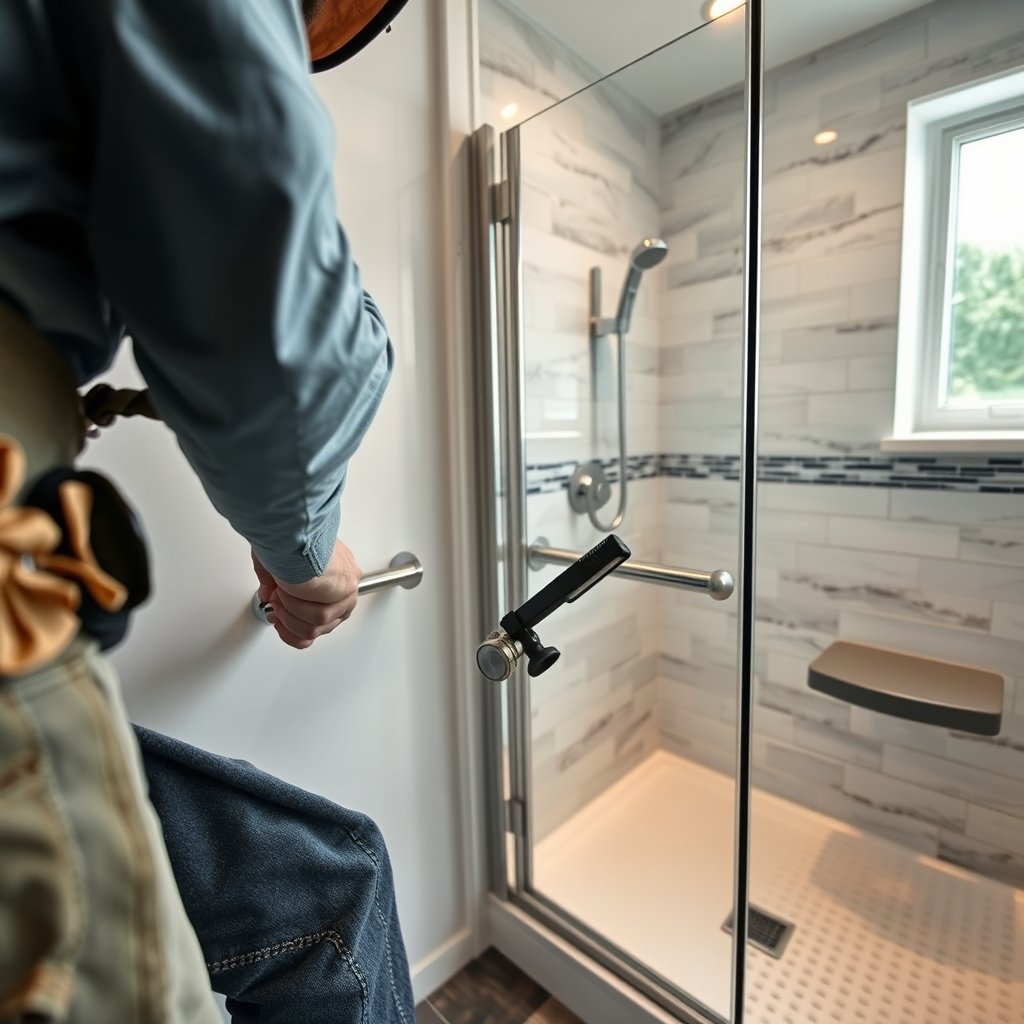
Bathroom upgrades offer the largest safety payoff. Most falls happen here, so targeted aging in place home modifications make an immediate impact. Essential changes include:
- Grab bars bathroom installation ($100–$400 per pair, installed near shower, toilet, or bath entry)
- Curbless (walk-in) showers or walk-in tub for elderly ($3,000–$12,000+ with plumbing)
- Non-slip mats, raised toilets, improved lighting, and wide entry doors
Even basic bathroom improvements cut fall risk by up to 38% among adults age 75+, according to SonderCare research. Small jobs (grab bars, handheld showers, slip-resistant mats) can run $500–$2,000. Larger conversions (full shower/tub, new sink/fixtures, demo/waterproofing) trend $7,000–$15,000. Always ask your contractor about the timeline—bath spruces might take 2–10 days while full conversions can stretch 2–4 weeks if plumbing or subfloor repairs are needed.
For a deep-dive into minor renovations, see our small bathroom remodel on a budget guide.
Walk-in tubs for elderly — costs, installation realities, pros/cons
Walk-in tubs and showers can be game-changers for elderly adults, but there are significant tradeoffs. Expect a typical walk-in tub for elderly to cost $3,000–$8,000 for the unit, with installation adding $1,000–$4,000 (especially if structural plumbing or electrical upgrades are needed). Things to consider:
- Space: Some models fit standard baths, but others require widened doors or reworking old plumbing.
- Usability: Choose between hydrotherapy features or simple easy-transfer models; the more features, the more potential trouble down the road (maintenance, leaks, cleaning).
- Installation time: 2–5 days for straightforward swaps, but up to 2+ weeks if you’re relocating drains, rerouting wiring, or repairing subfloor rot.
Weigh the pros (improved safety and comfort, ability to age in place) against the cons (cost, potential repairs, and—the big one—does your loved one want to bathe daily, or would a curbless shower make more sense?).
For more details on bathroom products and trends, see the global market update at FactMR.
Grab bars & small wins — cheap installs with high impact
Grab bars are the lowest-cost, highest-impact upgrade for aging in place home modifications. Well-placed bars reduce falls and help with balance and transfers. For code-compliant grab bars bathroom installation:
- Mount at 33–36 inches from floor (ADA standards)
- Secure into studs, not drywall anchors, for max weight support
- Use pairs at toilets and showers ($100–$400 installed)
- Where studs don’t align, reinforce with blocking or opt for fold-away bars
Consider using a contrasting color bar or textured grip for better visibility and safety. Need more organizational wins? Explore our garage storage system guide for clutter reduction alongside these small upgrades.
Ramps & entry access — costs, permanence, and site prep
Entry ramps are crucial if your loved one uses a wheelchair or walker. Wheelchair ramp cost ranges:
- Modular aluminum: $1,000–$3,500 for temporary/portable solutions
- Permanent wood or concrete: $2,500–$5,000+ (plus potential permits and site grading)
ADA guideline: 12 inches of run for every 1 inch of rise, with handrails and landings. Many delay proper ramp installs and patch with temporary steps—don’t. Site prep may add $500–$2,000+ for grading or removing shrubs.
Read more about affordable DIY improvement in our peel and stick backsplash article.
Stairlifts — straight vs. curved, price brackets, and installation time
If your parent will remain in a multistory home, stairlifts offer access without a full relocation. Stairlift installation cost varies widely:
- Straight stairlifts: $3,000–$5,000 new, often $2,000+ refurbished
- Curved rail systems (for landings or turns): $8,000–$15,000+
Installation typically runs 3–5 hours for a straight model and 1–2 days for custom curves (plus a 2–8 week wait for manufacturing). Check stairs for weight limits and request multiple bids. For more complex jobs, you may need a local building permit—timelines can double if your city is backed up.
Curious about other high-value tech upgrades? See our smart thermostat payback guide for energy savings ideas that pair well with accessibility.
Hidden costs & common real-world pain points to watch for
Most projects encounter at least one cost or timeline surprise. Key pain points reported in the 2024 industry report:
- Hidden structural issues (subfloor rot, termite damage, aging pipes) drive up costs by 10–40%.
- Delays due to permitting, inspections, or backordered equipment.
- Lack of code compliance leads to failed inspections and repeat work.
| Upgrade Type | Typical Cost Range | Timeline | Key Risks |
|---|---|---|---|
| Grab Bars | $100–$400 | 1–2 hours | Poor mounting; insufficient support |
| Walk-in Shower/Tub | $3,000–$12,000+ | 2 days–3 weeks | Hidden water damage; incorrect slopes |
| Ramps | $1,000–$5,000+ | 1–7 days | Foundation issues; uneven grading |
| Stairlift | $3,000–$15,000+ | 1 day–8 weeks | Power supply; weight limits; delayed parts |
So, always pad your schedule and budget. Plan for a 15–20% contingency to cover surprises and prevent safety gaps from partial fixes.
Top gaps in current guides — what most how-tos miss (and what we’ll include)
Most “how-to” guides miss three essential realities:
- Financing options: Few explain local, state, or national programs, leaving families to pay out-of-pocket.
- Local accessibility standards: ADA guidelines aren’t always local law; standards and permitting vary from city to city, so what’s “legal” elsewhere may fail inspection in your town.
- Clear timelines: Many guides gloss over how long projects actually take—including design, bids, permits, supply-chain delays, and post-work inspection.
To avoid these pitfalls, always ask contractors these questions:
- What funding/grant programs am I eligible for locally?
- Do you follow both ADA and my local code requirements?
- What is the standard permit process here? Will you coordinate inspections?
- Can you give a written start and finish date—and what are the penalties for delay?
Curious about larger remodel ROI and trends? Read our deep-dive on renovation development.
Financing & cost-reduction playbook (grants, loans, VA benefits, tax strategies)
With over 83% of spending done directly by homeowners, it pays to research every funding path. Mix and match these options for bigger projects:
- Local Area Agencies on Aging or ADRCs—check for grants or “handyman” programs
- State-administered Medicaid waivers or VA Home Improvement and Structural Alterations (HISA) grants
- FHA Title I home improvement loans (no equity required), or traditional home-equity loans—learn more in our renovation financing guide
- Nonprofits (e.g., Rebuilding Together) for labor donations
- Tax credits for energy or access upgrades—eligibility varies by state
Cut costs with phased work, used/refurbished equipment (check for gently used stairlifts), or prefab modular ramps rather than custom concrete pours. For more creative cost controls, see our article on outdoor kitchen cost—many principles apply to phased aging in place upgrades as well.
Timeline & permitting — realistic schedule and coordination plan
Construction timelines lengthen fast if you skip planning. Expect:
- Small jobs (grab bars, portable ramps): 1–2 weeks including bids and approval
- Medium jobs (bath/shower install, permanent ramps): 2–6 weeks—plan for demo, inspections, and finish work
- Major overhauls (multiple rooms, stairlifts, widening doors): 2–3 months or more (permits, design, contractor pipelines)
Checklist to stay on schedule:
- Gather three itemized bids and request written start/end dates
- Submit permit applications immediately after choosing contractor
- Schedule progress inspections with local building office
- Request contingency for part backorders or weather delays
Always ask if your contractor has dealt with your city’s specific review process before—permits and wait times can vary dramatically.
For tips on scheduling large projects, check out our garage conversion ADU guide.
Choosing contractors & credentials — who to hire and what to verify
Who you hire matters. For aging in place home modifications, check that your pro holds these:
- CERTIFIED AGING-IN-PLACE SPECIALIST (CAPS) or similar credentials
- Licenses for plumbing/electrical where needed
- Proof of insurance, workers’ compensation, and bonding
- References from recent, similar jobs
- Written contract with clear work scope, start/end dates, payment schedule, penalties for overrun
Ask these red flag questions:
- Can you provide photos of recent local aging in place home modifications?
- Will you coordinate with my city’s building department?
- What is your protocol if hidden damage or scope changes are found?
Contractor availability surges in high-demand regions; in the Southeast or Midwest, book early to avoid long waits. Interested in other smart upgrades? See how a smart door lock enhances safety for aging parents.
Case examples & budget templates (low, medium, high)
Use these real-world scenarios to build your project budget:
| Scenario | Components | Total Cost | Contingency |
|---|---|---|---|
| Low budget (Small bathroom safety) | Grab bars ($200), Non-slip mats ($100), Raised toilet seat ($150) | $450 | $100 |
| Medium budget (Shower conversion + entry ramp) | Curbless shower ($7,000), Grab bars ($300), Modular ramp ($2,500) | $9,800 | $2,000 |
| High budget (Full retrofit + stairlift) | Walk-in tub for elderly ($9,000), Stairlift installation cost ($4,000), Widen doors ($3,500), Custom ramps ($4,500), Lighting & fixtures ($1,500) | $22,500 | $5,000 |
For even more component-level pricing, check our window replacement cost breakdown.
Quick decision checklist & next steps for the reader
- Assess fall risk room by room—look for slippery surfaces, loose rugs, narrow doors
- List bathroom and entry modifications as first priorities
- Contact at least 3 CAPS-certified contractors and get itemized bids
- Photograph obstacles (narrow doors, stairs) for quotes
- Confirm local permit requirements up front
- Gather financing sources early; look for grants/loans before finalizing work
- Schedule projects in phases if needed to match funding
- Pad your budget by 15–20% for contingencies and surprises
Immediate next steps: 1) Measure your bathroom doorway width. 2) Photograph entry steps and hallway bottlenecks. 3) Call two reputable local contractors for a first estimate.
With careful planning, aging in place home modifications protect your budget, timeline, and—most importantly—your loved one’s independence. Don’t delay; every step you take now can prevent an accident later.
FAQ
How much do aging in place home modifications typically cost?
Most targeted projects range from $2,000 to $8,000 for essential upgrades. Full home retrofits can climb to $60,000 or more, especially if you need stairlifts, ramps, or multiple bathrooms updated.
Are there grants or financial aid for this type of project?
Yes, many local, state, and federal programs can help offset costs. Examples include Area Agency on Aging funds, VA HISA grants, and FHA Title I loans. Always check with a local resource center first.
How can I find a qualified contractor for aging in place home modifications?
Look for a Certified Aging-In-Place Specialist (CAPS), and always verify licenses, insurance, and experience with similar projects. Ask for local references and insist on a written, itemized estimate and contract.
What areas of the home should I modify first?
Start with the bathroom and main entry. These areas present the greatest fall and access risks. Add grab bars, convert showers, and fix narrow entrances before tackling less critical upgrades.